Invest in your 30s
You're working hard.
Is your money too?
You're working hard.
Is your money too?
You're in your 30s. Investing $25/day can make you a millionaire over time. Find out how and discover more money school lessons below!
💡Money School Lesson #1
Understanding Your Prime Investment Years
Your 30s are what financial experts call the "wealth acceleration decade." You're likely earning more than in your 20s, but you still have 30+ years until retirement — the perfect combination for valuable compound growth.
The Math:
At 8% average annual returns, $750/month for 30 years = +$1.1M. Wait 5 years to start? Investing $750/month for only 25 years can lead to missed returns of +$300K. Every year you delay doesn't just cost you contributions — it costs you all the compound growth those contributions would have generated.†
💰 Key Takeaway:
Starting in your 30s means time is still your biggest asset. You're not too late, and you're not too early — you're in the sweet spot where consistent investing can create life-changing wealth.
💡Money School Lesson #1
Understanding Your Prime Investment Years
Your 30s are what financial experts call the "wealth acceleration decade." You're likely earning more than in your 20s, but you still have 30+ years until retirement — the perfect combination for valuable compound growth.
The Math:
At 8% average annual returns, $750/month for 30 years = +$1.1M. Wait 5 years to start? Investing $750/month for only 25 years can lead to missed returns of +$300K. Every year you delay doesn't just cost you contributions — it costs you all the compound growth those contributions would have generated.†
💰 Key Takeaway:
Starting in your 30s means time is still your biggest asset. You're not too late, and you're not too early — you're in the sweet spot where consistent investing can create life-changing wealth.
💡Money School Lesson #1
Understanding Your Prime Investment Years
Your 30s are what financial experts call the "wealth acceleration decade." You're likely earning more than in your 20s, but you still have 30+ years until retirement — the perfect combination for valuable compound growth.
The Math:
At 8% average annual returns, $750/month for 30 years = +$1.1M. Wait 5 years to start? Investing $750/month for only 25 years can lead to missed returns of +$300K. Every year you delay doesn't just cost you contributions — it costs you all the compound growth those contributions would have generated.†
💰 Key Takeaway:
Starting in your 30s means time is still your biggest asset. You're not too late, and you're not too early — you're in the sweet spot where consistent investing can create life-changing wealth.
Created by Mr. Wonderful, Kevin O'Leary, and his team
"People think becoming a millionaire requires luck or a huge salary. It doesn't. It requires consistency and time. Setting aside $25 a day to invest consistently for 30 years can get you there. The math works — you just have to start."
— Kevin O'Leary, Chairman & Co-owner, Beanstox

💡Money School Lesson #2
💡Money School Lesson #2
Time is money, literally!†
Albert Einstein called it "the eighth wonder of the world." Here's why compound growth is your most powerful wealth-building tool in your 30s:
+$1.1M
What $750/month becomes by 65 when you start at 35
Your contributions: $270K. Compound growth: +$830K.
75%
Of your final balance is compound growth
You contribute 25%, the market does 75%
+$300K
Cost of waiting just 5 years to start
Starting at 40 vs 35 means potentially losing +$300K in growth when investing $750/month at 8% until 65
Key Takeaway:
Your money makes money, and that money makes more money. With 30 years ahead, $750/month could turn into over $1.1M not because you saved $1.1M (you only put in $270K), but because your money worked for you through compound growth. That's why starting in your 30s is still incredibly powerful.
Key Takeaway:
Your money makes money, and that money makes more money. With 30 years ahead, $750/month could turn into over $1.1M not because you saved $1.1M (you only put in $270K), but because your money worked for you through compound growth. That's why starting in your 30s is still incredibly powerful.
The 3-Step Wealth-Building System
Forget stock picking and market timing. Here's a simple system to build wealth over time:

01
Define your millionaire timeline
Define your investment goals and risk tolerance. Invest in a diversified portfolio designed to grow over time.
📚 Lesson: Financial clarity is the first step to financial freedom

02
Automate $750/month consistently
With Beanstox you can set it and forget it. Deposits move automatically into your investment account every month. This is called 'dollar-cost averaging' — you buy more shares when prices are low, fewer when prices are high. Over 30 years, this tends to smooth out market volatility and eliminates emotional decisions.
📚 Lesson: Automation removes emotion from investing
02
Automate $750/month consistently
With Beanstox you can set it and forget it. Deposits move automatically into your investment account every month. This is called 'dollar-cost averaging' — you buy more shares when prices are low, fewer when prices are high. Over 30 years, this tends to smooth out market volatility and eliminates emotional decisions.
📚 Lesson: Automation removes emotion from investing

03
Stay invested through market swings
You'll see ups and downs. Don't panic sell. With 30 years until retirement, short-term dips can be buying opportunities. Historically, the S&P 500 has never had a negative 20-year period. Just stay the course.
📚 Lesson: Time in the market beats timing the market
⚡ Pro Tip:
The biggest investing mistake isn't picking the wrong stocks — it's not investing at all. Studies show that 90% of investment success comes from asset allocation (being invested in the market), not stock selection. This system keeps you invested, diversified, and growing wealth over time.
⚡ Pro Tip:
The biggest investing mistake isn't picking the wrong stocks — it's not investing at all. Studies show that 90% of investment success comes from asset allocation (being invested in the market), not stock selection. This system keeps you invested, diversified, and growing wealth over time.
📖 Money School Lesson #4
Financial Concepts Every 30-Something Should Know
Understanding these fundamentals will help you make better financial decisions for the next 30+ years.
Asset Allocation
How you divide investments between stocks, bonds, and cash. In your 30s, most experts recommend 80-90% stocks for growth, 10-20% bonds for stability.
Why it matters: Proper allocation balances growth potential with risk management over decades.
Dollar-Cost Averaging
$750 every month, whether the market is up or down. This strategy automatically buys more shares when prices are low, fewer when high.
Why it matters: Removes emotion from investing and takes advantage of market dips.
Tax-Advantaged Accounts
401(k), IRA, and Roth IRA accounts that reduce your tax bill while building retirement wealth. Max them out first.
Why it matters: For every $100 you contribute to a Traditional IRA (available in Beanstox) you can boost your federal tax refund by up to $22. That's free money.**
Diversification
Spreading investments across many companies and sectors so one bad performer doesn't sink your portfolio.
Why it matters: For example, the S&P 500 index holds 500 companies. If 50 fail, you still own 450. Individual stocks? Much riskier.
📖 Money School Lesson #4
Financial Concepts Every 30-Something Should Know
Understanding these fundamentals will help you make better financial decisions for the next 30+ years.
Asset Allocation
How you divide investments between stocks, bonds, and cash. In your 30s, most experts recommend 80-90% stocks for growth, 10-20% bonds for stability.
Why it matters: Proper allocation balances growth potential with risk management over decades.
Dollar-Cost Averaging
$750 every month, whether the market is up or down. This strategy automatically buys more shares when prices are low, fewer when high.
Why it matters: Removes emotion from investing and takes advantage of market dips.
Tax-Advantaged Accounts
401(k), IRA, and Roth IRA accounts that reduce your tax bill while building retirement wealth. Max them out first.
Why it matters: For every $100 you contribute to a Traditional IRA (available in Beanstox) you can boost your federal tax refund by up to $22. That's free money.**
Diversification
Spreading investments across many companies and sectors so one bad performer doesn't sink your portfolio.
Why it matters: For example, the S&P 500 index holds 500 companies. If 50 fail, you still own 450. Individual stocks? Much riskier.
📖 Money School Lesson #4
Financial Concepts Every 30-Something Should Know
Understanding these fundamentals will help you make better financial decisions for the next 30+ years.
Asset Allocation
How you divide investments between stocks, bonds, and cash. In your 30s, most experts recommend 80-90% stocks for growth, 10-20% bonds for stability.
Why it matters: Proper allocation balances growth potential with risk management over decades.
Dollar-Cost Averaging
$750 every month, whether the market is up or down. This strategy automatically buys more shares when prices are low, fewer when high.
Why it matters: Removes emotion from investing and takes advantage of market dips.
Tax-Advantaged Accounts
401(k), IRA, and Roth IRA accounts that reduce your tax bill while building retirement wealth. Max them out first.
Why it matters: For every $100 you contribute to a Traditional IRA (available in Beanstox) you can boost your federal tax refund by up to $22. That's free money.**
Diversification
Spreading investments across many companies and sectors so one bad performer doesn't sink your portfolio.
Why it matters: For example, the S&P 500 index holds 500 companies. If 50 fail, you still own 450. Individual stocks? Much riskier.
5 Mistakes People in Their 30s Make
Learn from others' mistakes. Each of these errors can cost you six figures in lost retirement wealth.
Thinking '$750/month is too much'
hat's $25/day. Skip a few coffees, eating out, or an impulse buy. It's not about being rich now — it's about becoming a millionaire later. You either pay for lifestyle today or wealth for retirement.
Waiting for the 'perfect time' to start
There's always something — house, kids, car. But waiting 5 years means you need to invest way more to catch up. Start with $750/month by 35 or invest +$1,100/month at 40 for the same result.
Cashing out when the market dips
Market drops are normal. Selling locks in losses. Millionaires generally stay invested through ups and downs. You have 30 years — short-term dips don't matter.
Only investing 'extra' money
There's never extra money. Treat your $750/month like rent — non-negotiable. Pay yourself first, then budget the rest. Future millionaire you will thank you.
Trying to get rich quick
Chasing quick wins usually means quick losses. Boring, consistent investing in diversified funds is how most regular people who invest become millionaires. Slow and steady wins.
5 Mistakes People in Their 30s Make
Learn from others' mistakes. Each of these errors can cost you six figures in lost retirement wealth.
Thinking '$750/month is too much'
hat's $25/day. Skip a few coffees, eating out, or an impulse buy. It's not about being rich now — it's about becoming a millionaire later. You either pay for lifestyle today or wealth for retirement.
Waiting for the 'perfect time' to start
There's always something — house, kids, car. But waiting 5 years means you need to invest way more to catch up. Start with $750/month by 35 or invest +$1,100/month at 40 for the same result.
Cashing out when the market dips
Market drops are normal. Selling locks in losses. Millionaires generally stay invested through ups and downs. You have 30 years — short-term dips don't matter.
Only investing 'extra' money
There's never extra money. Treat your $750/month like rent — non-negotiable. Pay yourself first, then budget the rest. Future millionaire you will thank you.
Trying to get rich quick
Chasing quick wins usually means quick losses. Boring, consistent investing in diversified funds is how most regular people who invest become millionaires. Slow and steady wins.
5 Mistakes People in Their 30s Make
Learn from others' mistakes. Each of these errors can cost you six figures in lost retirement wealth.
Thinking '$750/month is too much'
hat's $25/day. Skip a few coffees, eating out, or an impulse buy. It's not about being rich now — it's about becoming a millionaire later. You either pay for lifestyle today or wealth for retirement.
Waiting for the 'perfect time' to start
There's always something — house, kids, car. But waiting 5 years means you need to invest way more to catch up. Start with $750/month by 35 or invest +$1,100/month at 40 for the same result.
Cashing out when the market dips
Market drops are normal. Selling locks in losses. Millionaires generally stay invested through ups and downs. You have 30 years — short-term dips don't matter.
Only investing 'extra' money
There's never extra money. Treat your $750/month like rent — non-negotiable. Pay yourself first, then budget the rest. Future millionaire you will thank you.
Trying to get rich quick
Chasing quick wins usually means quick losses. Boring, consistent investing in diversified funds is how most regular people who invest become millionaires. Slow and steady wins.
Your Questions, Answered
Can I really afford $750/month?
What if I'm 38? Can I still hit $1 million?
What if I can invest more than $750/month?
What if I need to stop investing for a few months?
7,212 people are already on the list
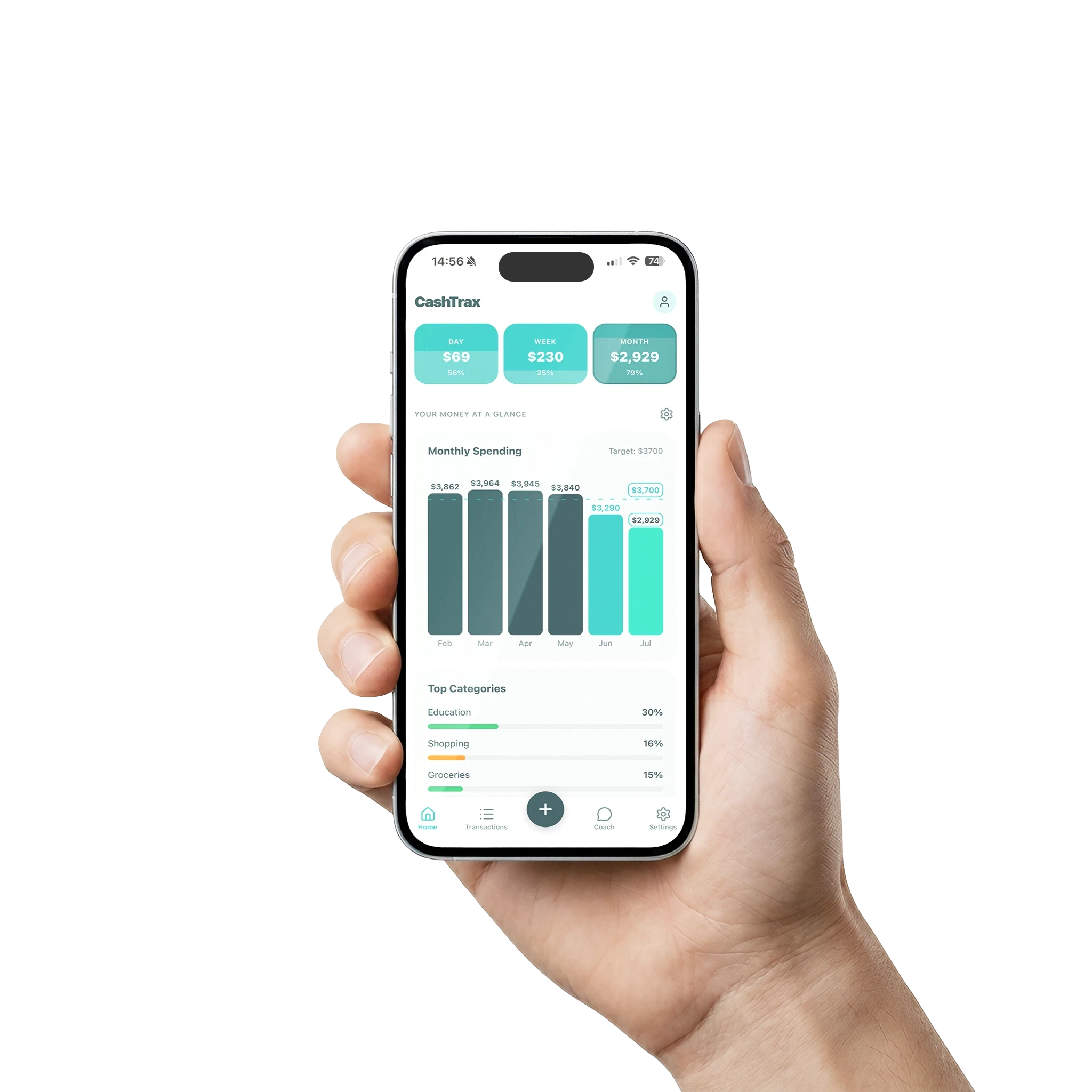
Get cashtrax early and watch your goals become reality
Get cashtrax early and watch your goals become reality
Founding clients get early beta access and a say in what gets built next.
Join the waitlist for priority access
Founding clients get early beta access and a say in what gets built next.